Hawk Core Curriculum
Explore general education courses that align with your degree pathway in the College Catalog
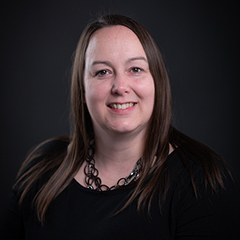
” When students can relate what they are learning to their future career, we see higher levels of engagement and interest in the subject. Dunwoody students are focused and they want their education to be the best use of their time and resources. By designing general education courses that not only meet the degree standards set by the Minnesota Office of Higher Education but do so in a way that directly benefits students professionally, we can provide a higher level of return on investment. “
Bridget Reynolds
Academic Dean, Office of Instruction
Hawk Core Curriculum & Your Technical Degree
Students seeking a degree in the skilled trades and technical fields often ask the question: why do I need to take general education classes?
While your technical courses give you the skills and expertise needed in your future profession, Core Curriculum classes give you the communication, problem-solving, collaboration, and decision-making skills that employers are looking for. In addition, degree-seeking students must meet Minnesota Office of Higher Education standards to fulfill their degree requirements. Dunwoody’s Hawk Core Curriculum both meets these standards and does so in a way that is practical and applicable to your future career.
The Department offers courses in five different content areas:
Communications
Communications is the study of how people share information, ideas, meaning, and culture. Communications offerings are designed to develop a student’s understanding and application of research and critical thinking skills necessary to evaluate information, identify and evaluate source material, integrate differing points of view, and establish a reasoned course of action for effectively solving problems and demonstrating effective verbal, nonverbal, and visual skills (i.e. reading, writing, speaking, listening, audience awareness, and conflict resolution).
Arts and Humanities
Humanities/Arts is the study of human culture and/or expression. Humanities/Arts offerings are designed to develop a student’s understanding of the relationship between a work of art or text and its cultural context and ability to form judgments through the critical and aesthetic analysis of works of art, literature, religion, history, and philosophy.
Social Sciences
Social Science is the study of human society and/or behaviors and cause and effect. Social Science offerings are designed to develop a student’s understanding of individual or social human behavior from the perspective of one or more disciplines of the social sciences, knowledge of empirical methods for studying human behavior, and to use theories and concepts of human behavior with appropriate empirical evidence to analyze contemporary social issues (historical events, cultural and societal differences), consumer behavior, and/or the inter-workings of an economy, how to analyze and interpret data from a social science context, and evaluate society as a whole.
Mathematics
Mathematics is the study of numerical relationships, geometrical and spatial properties, and/or logic. Mathematics offerings are designed to develop students’ understanding of basic mathematical concepts, to develop their abilities to analyze and solve mathematical problems, and to promote the importance of mathematics through analysis of problem solving strategies and the interpretation of results.
Natural Science
Natural Science is the study of the physical world and/or how biological life, non-living systems and matter, and/or energy works. Natural Science offerings are designed to develop a student’s understanding of the natural world, its processes, and the inter-relationships of its systems; how to apply the scientific method including the appropriate collection, analysis, and interpretation of data and effective communication of findings; harness the ability to use scientific terminology appropriately in meaningful scientific dialogue; and gain an understanding of the process of science as an intellectual pursuit and the ways in which scientific ideas evolve and come to be accepted.
Summer Classes
Want to pick up a few credits over summer? Check out the various Hawk Core Curriculum courses offered in Arts & Humanities, Communications, Social Sciences, or Math & Science.
Dunwoody offers two, four-week summer sessions one in June and one in July.
Students can register for the summer courses at the same time as they register for Spring Semester.
J-TERM
J-TERM is a three-week intensive learning opportunity to enroll in a Hawk Core Curriculum course in Arts, Humanities, Social Sciences, and Communications.
Enrolling in a J-TERM course will lighten your credit load during the regular semester.
We do recommend that students enroll in no more than one J-TERM course due to the compact learning time frame.
Students can register for J-TERM classes at the same time as they register for Spring Semester.
PSEO
Hawk Core Curriculum courses are available for PSEO students, earning the student dual credit towards both a high school diploma and a college degree.
Flexible Learning Options
The Hawk Core Curriculum delivers classes in flexible options for students including in-person, fully online, and hybrid.
Program Learning Outcomes for Arts, Humanities, Communications, and Social Sciences Courses:
| 1. Communicate Effectively | Construct written, oral, and visual communication for author, audience, text, context, and purpose. | |
| 2. Embrace Integrity | Apply ethically and civically responsible behaviors for professional and personal settings in a dynamic society. | |
| 3. Exhibit Curiosity | Collaborate to promote inquiry, discover solutions, and generate new ideas and creative works that are relevant and responsive to the world around them. | |
| 4. Collaborate Successfully | Explain concepts that influence the behavior and decisions of individuals and institutions. | |
| 5. Think Critically | Access, evaluate, and use information gathered through a variety of resources and technologies in developing projects and presentations. | |
| 6. Integrate Learning | Connect and transfer skills and learning among disciplines, domains of thinking, experiences, and situations. |
Program Learning Outcomes for Math & Science:
| 1. | Accurately explain information presented in mathematical forms (equations, graphs, diagrams, tables, words). | |
| 2. | Convert relevant information into various mathematical forms (equations, graphs, diagrams, tables). | |
| 3. | Use the analysis of data as the basis for drawing reasonable conclusions. | |
| 4. | Explore a topic in depth, to determine inter-related topics. | |
| 5. | Evaluate solutions taking into consideration the history of the problem, its feasibility or its impact. | |
| 6. | Propose a solution/hypothesis taking into consideration ethical, logical or cultural context. | |
| 7. | Identify multiple approaches for solving the problem within a specific context. |
MISSION
The mission of the Hawk Core Curriculum is to equip all Dunwoody students with the professional skills required by inclusive modern workplaces.
VISION
To deliver relevant general education classes that resonate with technical students where integrated and applied learning is the norm.
Questions about the Hawk Core Curriculum?
Bridget Reynolds
Dean of Instruction and Hawk Core Curriculum
Phone: 612.381.3373