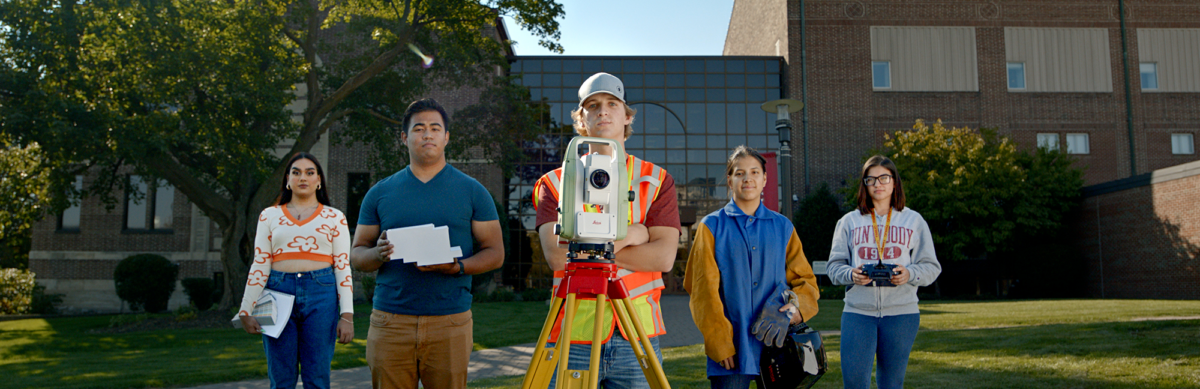
Making a career change can seem like a daunting task. The key to making a successful career change is to focus on a career that interests you, that has good job prospects, and that you can launch sooner rather than later.
One of the best approaches is to consider a two-semester certificate in a technical field, which allows you to graduate and start working in just nine months. Such credentials are even more effective if they roll up to further degrees so that your educational path can help you progress as you establish yourself in your new career field.
A Second Career is Closer than You Think
According to a 2021 survey by the Federal Reserve, nearly 40 percent of adults who went to college regret their choice of major. And for many working adults, the thought of “do-over” doesn’t seem very “do-able.”
A short-term certificate options can offer a second chance for a new career. Here are five in-demand, good-paying career changes you can make in less than a year.
Five options for making a career change in less than a year
Right Skills Now for Manufacturing (CNC Operator)
If you’re a problem solver with a high attention to detail and technical aptitude, you might want to consider a career in advanced manufacturing as a machinist and CNC operator.
From large medical manufacturers to small machine shops, the manufacturing industry is looking for skilled machinists to fill these roles. And with 70 percent of current machinists past the age of 45, the employment opportunities are only going to grow.
Dunwoody’s Right Skills Now for Manufacturing program is designed to fast-track you into this technologically advanced industry. You’ll learn the principles of metal-cutting and milling technology through hands-on projects in a state-of-the-industry Machine Shop that includes training on both manual mills and CNC (computer numeric controlled) machines.
This program also transfers into Dunwoody’s associate’s degree in Machine Tool Technology which then leads to our bachelor’s degree in Industrial Engineering Technology, so that you can advance in your education and career while you’re already working.
Welding Technology
If you’re creative, like working with your hands, and want a job that will give you the flexibility to find work wherever you go — welding could be a perfect fit.
The demand for welders has been growing, and the Bureau of Labor Statistics projects the industry will have more than 47,000 openings on average each year for the next decade. This versatile career has opportunities across a wide range of industries and sectors, including construction, manufacturing, energy, aerospace, marine/shipbuilding, and railroads.
A certificate in Welding Technology from Dunwoody College will train you to be a professional welder in just two semesters. The program aligns with the standards set for by the American Welding Society and teaches you all the standard welding methods used in industry, including oxygen-fuel and cutting, shielded metal arc, gas metal arc, and gas tungsten arc.
This program also transfers into Dunwoody’s associate’s degree in Welding & Metal Technology which then leads to our bachelor’s degree in Industrial Engineering Technology, so that you can advance in your education and career while you’re already working.
Electronics Technician
People who are detail-oriented, learn by trial and error, and have an interest in how electronics work and how to make them work better might be interested in a career in electronics. It’s an area of technology that literally makes our world function, and it’s often on the cutting edge of new technologies.
Electronics Technicians are needed in almost every sector of manufacturing: aerospace, medical device and semiconductor manufacturing companies lead the way. And with a 100 percent placement rate in the field, graduates from the Dunwoody program are in high demand.
Dunwoody offers a one-year certificate in Electronics Technology and classes are offered in the evening, making it a good option for working professionals looking to switch gears. You’ll learn the basics of electricity and electronics and how to design, build, and troubleshoot digital circuits.
This program also transfers into Dunwoody’s associate’s degree in Electronics Technology which then leads to our bachelor’s degree in Automation & Controls Engineering Technology, so that you can advance in your education and career while you’re already working.
Construction Project Management
Like working with people and enjoy seeing the tangible results of the projects you work on? Interested in the challenge of planning and executing complex construction projects? You may want to consider a career in construction management.
Graduates from this program are well equipped to enter the construction industry as project managers and estimators. While prior experience in the construction industry is helpful, it’s not necessary, and Dunwoody has a pathway to gain further education in construction management.
In just two semesters, Dunwoody’s Construction Project Management certificate can prepare you with the skills needed to develop construction plans and schedules and estimate project costs. You’ll learn industry-standard software, including Autodesk, OnCenter QuickBid, RSMeans CostWorks, and more.
This program also transfers into Dunwoody’s associate’s degree in Construction Project Management which then leads to our bachelor’s degree in Construction Management, so that you can advance in your education and career while you’re already working.
Land Surveying
Whether you’re just starting out, or looking for a second career, there’s a lot of things to love about a career in land surveying. And if the idea of working outdoors, using high-tech equipment, and solving problems appeals to you, this might be your calling.
According to beasurveyor.com, projections from the U.S. Department of Labor show the need for land surveyors and technicians will outpace the average growth for all occupations.
Although this does require already having a bachelor’s degree, the one-year Land Surveying program at Dunwoody offers a pathway to becoming a licensed surveyor. If you don’t yet have a four-year degree, then the two-year associate’s degree in Surveying & Civil Engineering Technology is the better route.
At Dunwoody, the program placement rate for both the Land Surveying and the Surveying & Civil Engineering Technology degree programs is 100 percent.
FIND OUT MORE
Interested in learning more? Attend one of our monthly Open Houses to speak with faculty and tour the campus or meet one-on-one with an Admissions counselor. You can also email admissions@dunwoody.edu.