When the Schultz family was searching for a way to support their toddler’s mobility, they found both innovation and community at Dunwoody College of Technology.
Their daughter, who has Down Syndrome, had been using a ZipZac2 mobility chair during her physical therapy appointments. The device dramatically increased her motivation to practice mobility exercises and explore her environment. However, the ZipZac chair wasn’t covered by insurance, and the company that developed it has discontinued the product.
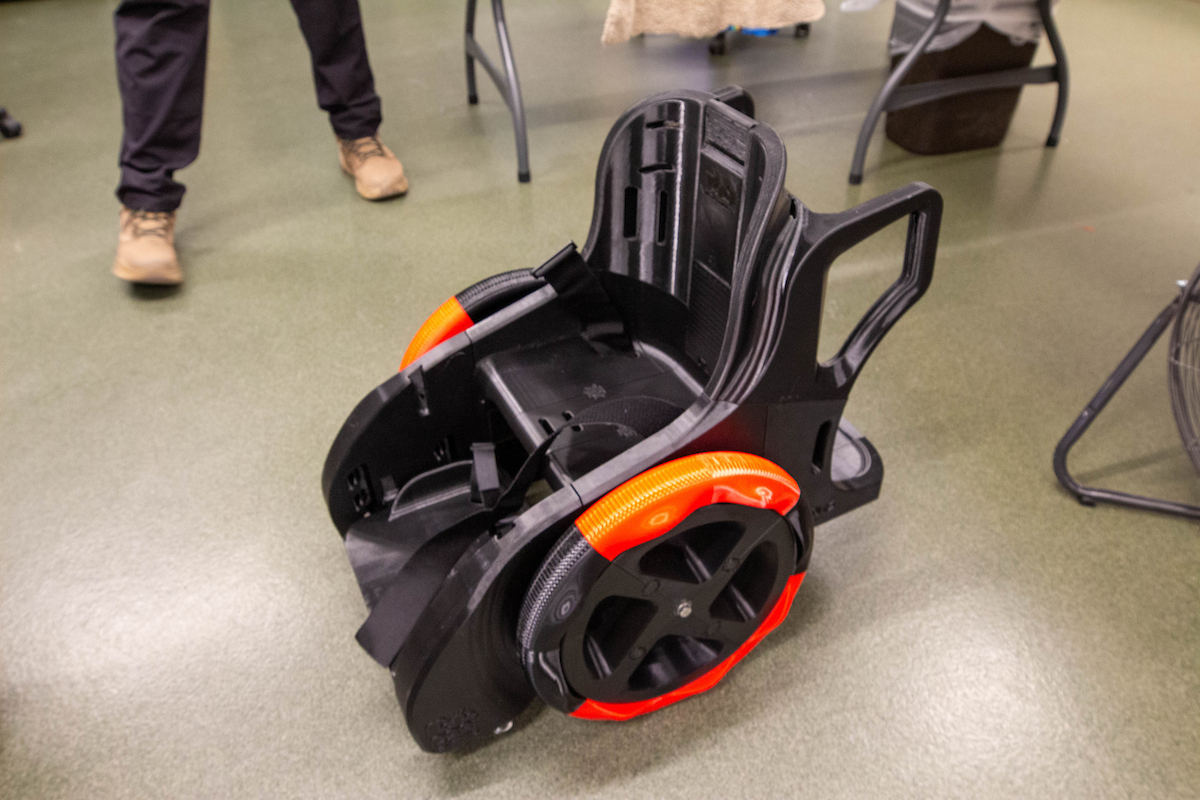
The Schultz family reached out to Dunwoody to create a solution. Using an open-source design and the College’s state-of-the-art 3D printers, a team of Dunwoody students and faculty helped produce a 3DTMT (3D Printed Toddler Mobility Trainer), an affordable mobility device created by the nonprofit Tikkun Olam Makers. The device is designed to help toddlers with limited mobility gain independence through safe, supported movement.
“What we’re really looking for is if she can gain independence in her walking,” said a member of the Schultz family. “This is a fun and safe way to get excited about mobility and to get her moving.”
The impact was immediate.
“This is huge,” one of the parents shared. “This looks more solid than the one she’s been using. I couldn’t believe how perfectly it fits her. It’s a whole new level of freedom.”
The recipient of the device shares a special bond with her twin. During the meet-up to test the final product, the sister excitedly pushed her twin in her new mobility device, and encouraged her to move, explore, and play alongside her.
For the Schultz family, the device represents more than just a piece of equipment: it’s a step towards autonomy, confidence, and continued development.
For Dunwoody, the project reflects something even bigger.
Learning engineering and manufacturing isn’t just about making parts—it’s about making a difference. Through hands-on learning and community partnerships, the students and faculty at Dunwoody are helping make an impact, one life-changing device at a time.