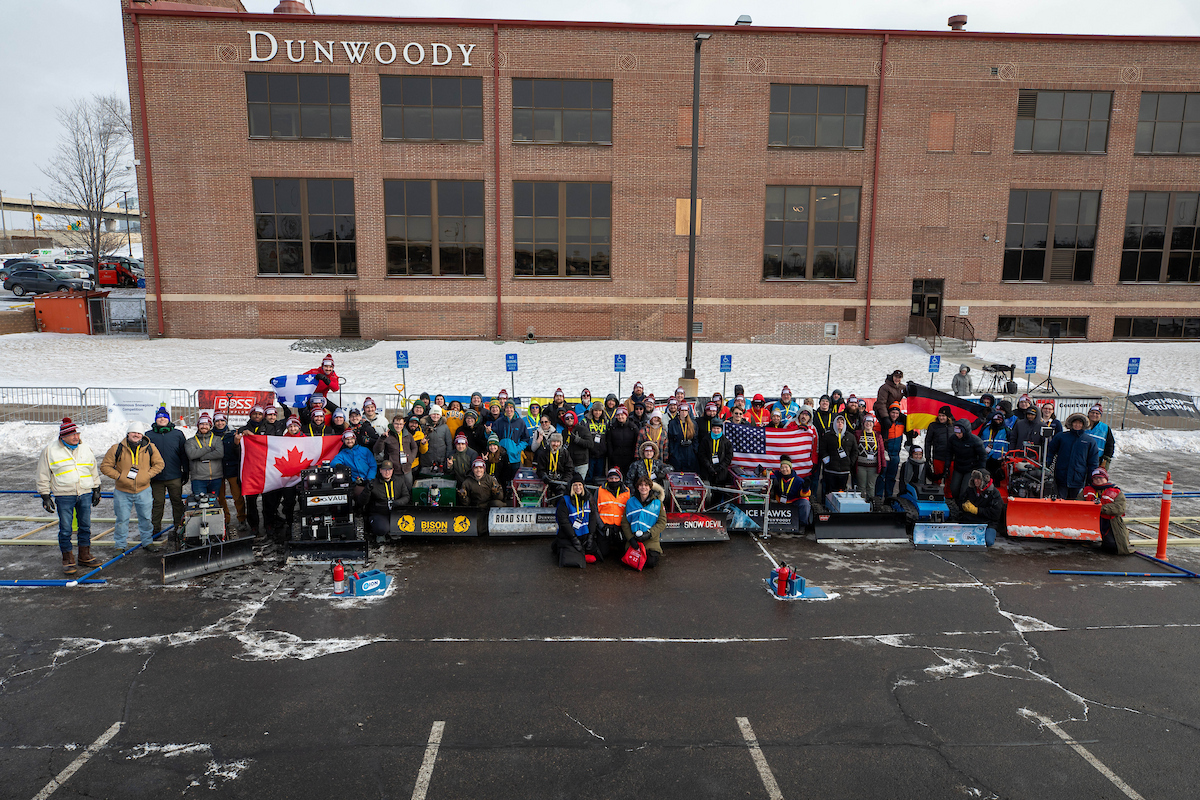
The 16th Annual Autonomous Snowplow Competition (ASC) brought together students from across the country and beyond to design, build, and operate fully autonomous snowplows capable of clearing a simulated winter driveway and sidewalk. Over the past 16 years, more than 30 teams from 25 institutions have competed, making the ASC a unique and challenging student robotics competition.
This year marked a major milestone: for the first time, teams from three different countries participated in the competition.
The competition challenges teams to remove snow from the field which is shaped like a “T” to simulate a driveway leading into a sidewalk. To do so, teams must avoid obstacles, stay within the boundaries of the course, and return safely to the garage. Teams are scored based on snow removal, obstacle navigation, and successful return to garage. Any infractions to the rules could cause a decreased score — every point matters!
Despite light snowfall throughout the day, teams pushed forward, navigating orange and yellow cones as obstacles and blue poles that defined the course boundaries. The snowy conditions posed a real-world challenge as excess snow can interfere with sensors, disrupt visual navigation systems, and test the reliability of autonomous controls.
Meet the teams:
Weasel — Université Laval (Quebec, Canada)
Team Weasel delivered one of the most impressive performances in ASC history, earning the highest score and securing first place. Their robot uses advanced LiDAR (Light Detection and Ranging) technology, and the team is internationally recognized as world champions of the F1Tenth autonomous vehicle competition hosted in Japan. After being delayed for hours in a blizzard on their way to this event, their performance proved their resilience and engineering excellence. Their name will now be added to the ASC Champions banner.
Lynx — University of Stuttgart (Germany)
Team ARTUS from the University of Stuttgart made their debut with their robot Lynx. This team was founded in 2024 by a group of engineering majors. They showcased innovation with 3D-printed drive wheels and a robot trained in the snowy Black Forest. Their strong performance earned them fourth place. They also won the Dr. Nattu Award for sportmanship.
Ice Hawks — Dunwoody College of Technology
Dunwoody’s Ice Hawks team earned an impressive second-place finish. Their robot used QR-code based navigation boards and an advanced vision system similar to NDSU’s robot, Hyflex. Despite some initial challenges, Ice Hawks came out near the top!
Otto — Case Western Reserve University
Otto has been competing in the ASC since 2013. This year it returned to ASC after previously competing in an autonomous lawn mowing competition. The robot is powered by lithium polymer batteries and uses skid steering. Otto is known as a jack of all trades, capable of mowing lawns, tending fields, watching over horses, and plowing snow. The Case Western team secured third place in this year’s competition.
Road Salt— Dunwoody College of Technology
Team Road Salt is made up of students from Dunwoody’s Robotics and Automated Engineering programs. Road Salt uses magnetic sensors and embedded magnetics strips along the edge of the course to guide their plow.
Hyflex— North Dakota State University
NDSU’s returning robot, Hyflex weighs more than700 pounds and is based on an articulated tractor design. Known for pulling people on sleds and a strong battery life, Hyflex completed its run with confidence. The team is rumored to be building a second robot for the 2027 competition supported by their school’s new engineering complex.
Snow Devil— Dunwoody College of Technology
Dunwoody’s most junior team began working on their robot just one month prior to the snowplow competition. Team Snow Devil is made up of students from Dunwoody’s Computer Networking, Engineering Design, and Robotics programs. Like Team Road Salt, Snow Devil also used magnetic strips except in a new configuration and had added extra weigh to improve their snow clearing ability.
Oh Hex Snow — North Dakota State College of Science
Oh Hex Snow was the only plow powered by AC variable frequency drives. They also borrowed an inverter from the school’s solar array. The team is made up of all electrical engineers!
Snow Clone — Iowa State University
Iowa State’s Snow Clone underwent a complete redesign this year, transitioning from a wooden frame to an aluminum extrusion chassis. The wide, chain-driven robot faced challenges with their LiDar systems. The team also competes in combat robotics!
Badger Mammoth — University of Wisconsin
The three team members on the University of Wisconsin-Madison’s team are all mechanical engineering majors. Their plow the Badger Mammoth has an 850 cc gas powered engine that can also be driven using a PS4 Controller.
Final Standings
- Université Laval
- Dunwoody College – Ice Hawks
- Case Western Reserve University
- University of Stuttgart
- North Dakota State University
- Dunwoody College – Road Salt
- Dunwoody College – Snow Devil
- Iowa State University
- University of Wisconsin
- North Dakota State College of Science
Best Poster Award: Université Laval
Dr. Nattu Award: University of Stuttgart
Congratulations to all the teams who were able to compete this year!
As one observer in the competition’s livestream noted, “Regardless of the weight of the plows, snow is the loudest thing we see.”
With expanding international participation and evolving technology, the Autonomous Snowplow Competition continues to push the boundaries of engineering — one driveway at a time