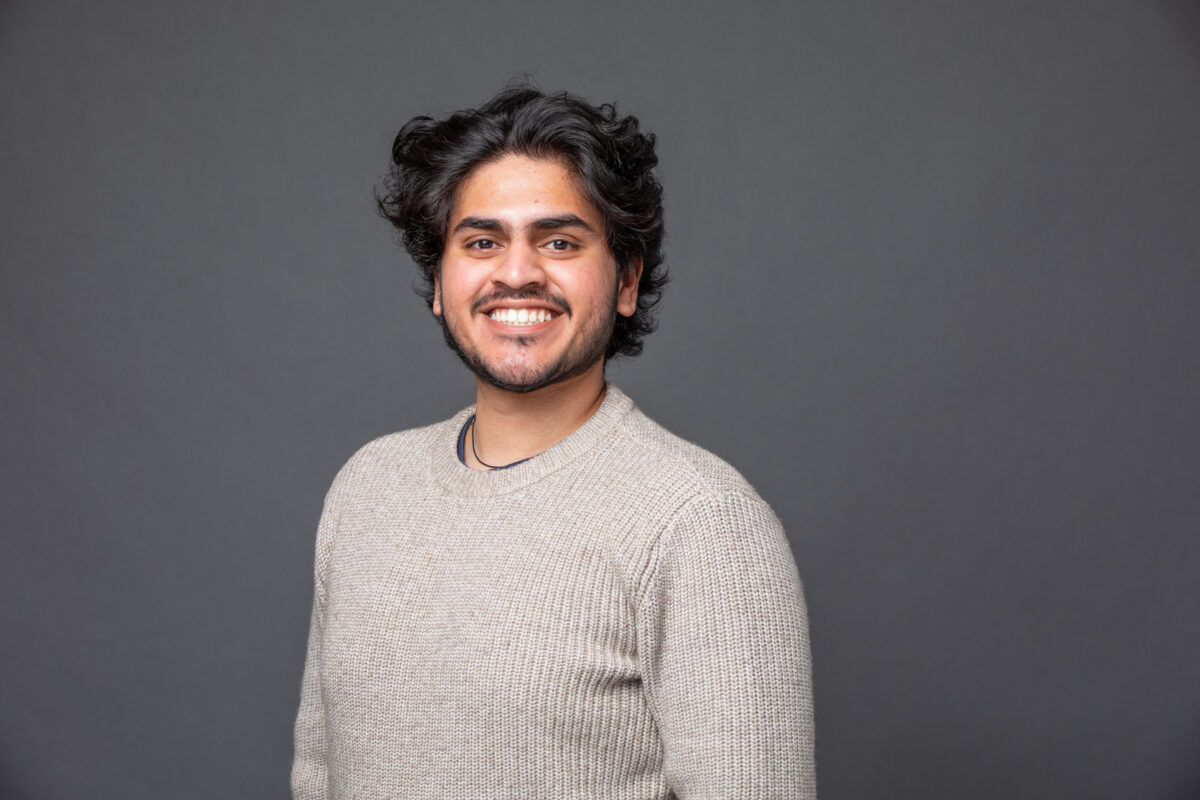
Immanuel Bhonsle grew up in Sharjah, United Arab Emirates, at a time when it was undergoing rapid urban development. That experience stuck with him even after he and his family moved to the United States, eventually settling in the Twin Cities.
“I was constantly fascinated by the buildings rising around me and found myself wondering how they came to be,” Bhonsle said. “In high school, I took courses in architectural design and civil engineering, which deepened that curiosity. I later pursued engineering at the university level, but after two years, I realized it wasn’t the right fit. Through some reflection, I recognized that what truly drew me was the design side — the shaping of forms and spaces, rather than the structural and technical problem-solving that engineering demanded. That realization led me to architecture.”
While at Dunwoody, Bhonsle has become involved in campus student groups, helping to revitalize the American Institute of Architecture Students (AIAS) chapter at the College as secretary and treasurer as well as taking a leading role with the National Organization of Minority Architecture Students (NOMAS) including serving as president and vice president.
During his time at Dunwoody, Bhonsle has not only taken on the core responsibilities of his official roles with student organizations, but also embraced them as opportunities to do more to help strengthen the campus community and represent Dunwoody to the rest of the world. This includes serving on the Student Leadership Council 2023 – 2026 and ranged from: organizing a tour of the Minnesota American Indian Center led by the architect who designed the building; creating an end-of-semester potluck to celebrate graduating students; and serving as the student speaker at the inauguration for President Scott Stallman.
His many efforts to connect members of the campus community together led to being nominated for and receiving the Unity in Action award, which is given to students or projects that demonstrate and heighten Dunwoody’s commitment to ensuring individuals have opportunities to learn and build awareness of a variety of life experiences.
As Korrin Howard, Associate Dean of School of Design and Associate Professor, noted when she presented the award to Bhonsle:
“Immanuel has played a key role in strengthening the Dunwoody AIAS and NOMAS Boards by fostering connections with local, regional, and national partners. Through collaborative leadership, Immanuel helped organize impactful opportunities including studio visits, portfolio workshops, a bridge‑building competition, Career Day programming, professional development updates, and student participation in regional and national AIAS conferences.”
“Receiving this award came as a genuine surprise, and I feel humbled by it,” Bhonsle said. “Growing up in Sharjah, UAE, and having lived across different cultures before coming to Minnesota, I have always felt that sharing perspectives and fostering understanding between people was simply a natural part of who I am, not something I thought of as award worthy. To have that recognized by Dunwoody means a lot to me.”
This community-focused approach is something that Bhonsle extends to his academic work as well.
“Architecture is about people at its core; designing spaces that serve and reflect the communities they belong to,” he said. “I believe that understanding diverse lived experiences makes you a more thoughtful and empathetic designer. This award reinforces my commitment to carrying that mindset with me beyond my time at Dunwoody.”
Bhonsle is working at RSP Architects for the summer. As he plans for the next steps in his career, he finds himself “particularly drawn” to the public sector where he hopes to work on civic, cultural, higher education, and K-12 design projects.
“I want to design for people,” he said. “I am drawn to civic, cultural, and educational architecture because those building types touch the widest range of lives, from individuals who use them daily, to those who simply pass by. A well-designed building or landscape has the power to impact an entire community, and that is what excites me every day. My goal is to contribute to spaces that are not only functional but are meaningful to the people they serve.”